
Store-Related Questions
Do you have any physical retail locations?
Yes, we have three retail locations across Western Canada. Visit our Locations tab to learn more about them, including hours of operation and telephone numbers.
What are your retail locations' hours of operation?
October - March
Spruce Grove, AB
Monday to Friday: 8:00am - 4:30pm
Tisdale, SK
Monday to Friday: 8:00am - 4:30pm
Winnipeg, MB
Monday to Friday: 8:30am - 5:00pm
April - September
Spruce Grove, AB
Monday to Friday: 8:00am - 5:00pm
Tisdale, SK
Monday to Friday: 8:00am - 5:00pm
Winnipeg, MB
Monday to Friday: 8:00am - 5:00pm
**After Hours pick up available upon request
How much is my shipping going to cost?
To determine your shipping cost, simply add the items you want to your cart and enter your address at checkout. It’s quick and easy!
Do you ship internationally?
No, we only ship within Canada.
Who are your shipping partners?
Our shipping partners are Purolator, Canpar Express, FedEx, UPS, and Canada Post.
For large orders, please contact your local retail location to arrange.
Beekeeping-Related Questions*
What's the difference between miticides?
There are quite a few differences between miticides, including how they work, application methods, and safety for your bees. To help you compare your options, we recommend checking out this Varroa Mite Product Comparison chart.
What should I feed my bees in the fall?
Colonies should be fed a thick 2:1 syrup in the fall. A single colony should weigh between 38.5 kg – 47.6 kg (85lbs and 105lbs), and a double colony should weigh between 63.5kg – 72.5kg (140lbs and 160lbs), going into a Canadian winter.
Do you sell nucs?
Yes, we sell nucs! Availability is variable depending on the time of year, so check out our Live Bees section for more details.
Do you sell queens?
Yes, we sell queen bees! Availability is variable depending on the time of year, so check out our Live Bees section for more details.
Do you sell bee packages?
Yes, we sell bee packages! Availability is variable depending on the time of year, so check out our Live Bees section for more details.
Should I feed my bees dry pollen, Patties, or both?
When colonies are short of pollen, brood rearing will decline. Using dry pollen substitute in an external feeder supports the bees' natural foraging behavior during favorable weather. During inclement weather, a pollen patty will ensure the hive gets protein directly.
How do I prepare my hive for winter?
Colonies should already have been fed and treated for Varroa mites in the fall before wrapping your hives for winter. Provide a windbreak from the north and west winds. Reduce the bottom entrance with an entrance reducer and provide an upper entrance for moisture to escape. Most inner covers have two sides: one flat and one with a notch for winter ventilation. Wrap your hives with a winter wrap. They can be homemade or purchased relatively inexpensively. The sides should have an insulation R-value of R8, and the top should have an insulation R-value of R20.
How do I install a nucleus colony (nuc)?
There are many ways to install a Nucleus colony, but the way preferred by our Sales & Member Relations Manager is as follows. Set up your hive equipment in the location where it will be situated for the season. Place your Nuc on the top of your hive when you get home, with the opening facing the same direction as your hive. Open the entrance to your nuc, allowing the bees to orient themselves to their new location. The following day, install the nuc into their new hive. You can install the nuc the same day you bring it home, but they will be stressed, agitated and not a lot of fun to work with. Remove 4 or 5 frames (depending on the size of the nuc you purchased) from the center of your hive and put your nuc frames exactly the way they came out of the nuc box into the hive box. Install your inner and outer covers, and you are done! Check on them in 2 to 4 days.
How do I install a queen bee?
There are numerous ways to introduce a new queen to the colony. One way is to suspend the queen cage that has the entrance blocked off with a candy or fondant between two frames within the hive. The worker bees will gradually get used to the new queen and her pheromones and eat through the candy, releasing her.
How do I assemble a hive?
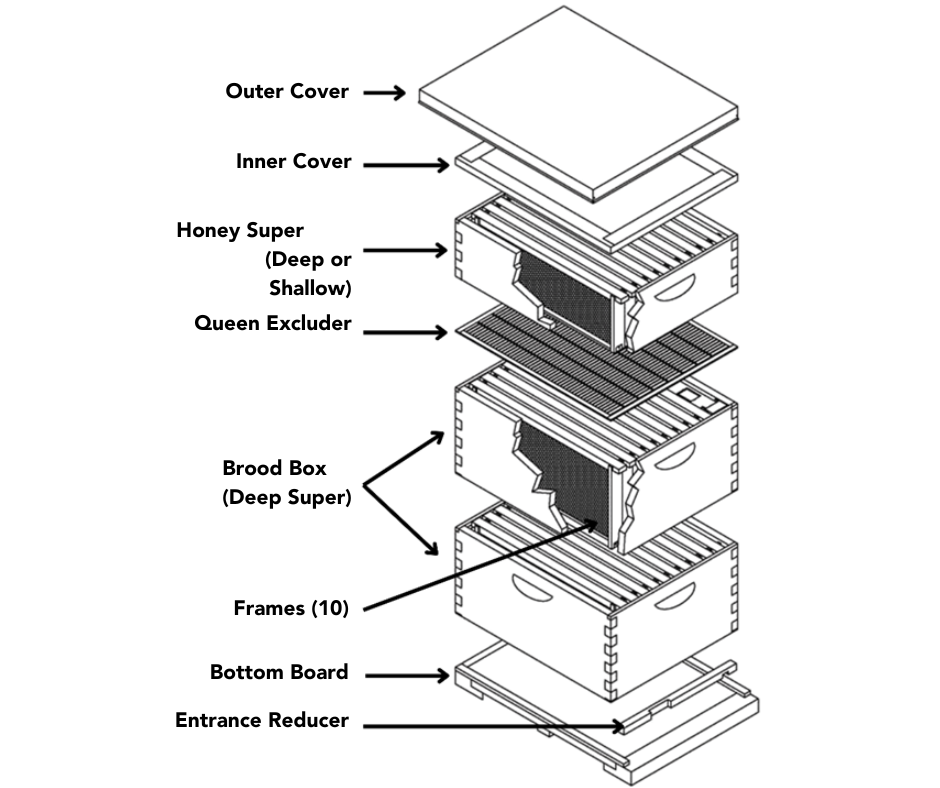
The basic components of a beehive are the bottom board, with or without an entrance reducer, depending on the time of year. On top of the bottom board are one or two brood boxes consisting of 10 removable frames and foundation. If honey supers are added, a queen excluder is generally placed on the top of the brood box and under the honey supers. On top of the queen excluder are the Honey supers with removable frames and foundation. On top of the honey supers is an inner cover and then an outer cover.
What protective gear do I need?
A suit (or jacket) and gloves. Other equipment that you may want to consider is a smoker and a hive tool.
Do I need to feed my bees in the winter?
Colonies should be fed in the fall before being put away for the winter. Feeding in the winter is stressful on the bees as the feed must be dried, stored, and capped. For added insurance, a winter fondant may be added before wrapping your hives.
How do I prevent swarming?
Swarming is a colony’s natural way of reproduction. Following the Beekeeping 7/10 rule can help alleviate the colony's urge to swarm. When 7 out of 10 frames in the box are drawn out or filled with comb, brood, or honey, add another box.
*Disclaimer
Beekeeping can be practiced in many different ways, and the best approach may vary depending on your location, climate, and individual circumstances. The information provided here is general in nature, and specific solutions may differ based on regional conditions and practical needs. For guidance tailored to your situation, we encourage you to reach out to your local beekeeping clubs or associations to hear what’s been working for others in your area or connect with your provincial apiarist for expert support.